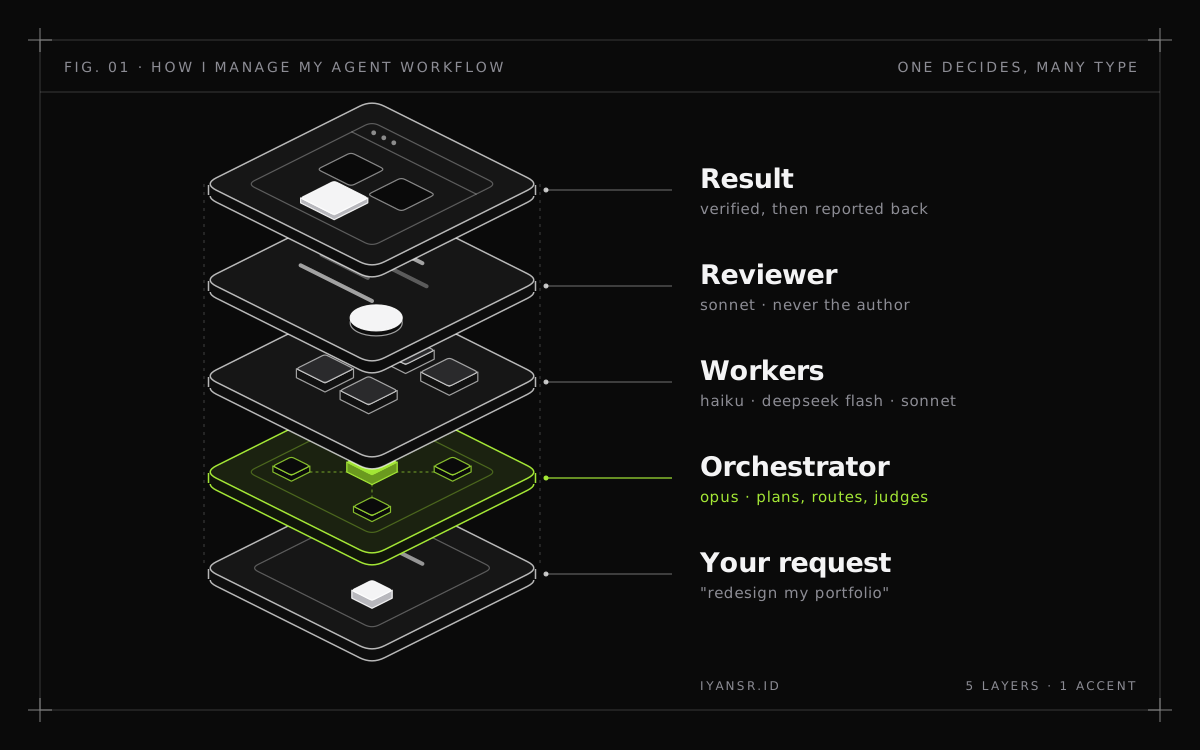
For a long time I ran one model for everything. The same expensive model planned the work, read forty files, wrote the code, ran the tests, and fixed its own typos.
That is a waste. Most of the tokens in a coding session go to reading files and writing edits, not to deciding what to build. Deciding is the hard part. Reading and typing are not.
So I split the two. One model decides. Cheaper models do the reading and the typing.
The setup
I use oh-my-pi (omp) as my coding agent. It lets me give each kind of subagent its own model. This is what I run today:
| Agent | Model | Job |
|---|---|---|
| Orchestrator | Claude Opus 5.5 | Plans, routes, judges results, talks to me |
scout | Claude Haiku 5.5 | Read-only search. Finds code and facts before planning |
task | DeepSeek Flash | Routine non-UI work, commands, checks. The default worker |
frontend | Claude Sonnet 5.5 | Anything UI: components, CSS, layout, accessibility |
sonic | Claude Haiku 5.5 | Mechanical edits: renames, find-and-replace |
deep-task | Claude Sonnet 5.5 | Cross-file design, subtle bugs, security-sensitive code |
reviewer | Claude Sonnet 5.5 | Reviews the integrated change. Never the agent that wrote it |
Every request goes to the orchestrator first, and it decides where the request goes. Watch a few requests take different routes, or hover a station to send one there yourself.
The model routing is a few lines in ~/.omp/agent/config.yml:
modelRoles:
  default: anthropic-3/claude-opus-5-5:medium
  task: deepseek/deepseek-flash:high
  deep: anthropic-3/claude-sonnet-5-5:high
  frontend: anthropic-3/claude-sonnet-5-5:high
  smol: anthropic-3/claude-haiku-5-5:high
retry:
  fallbackChains:
    task:
      - anthropic-3/claude-haiku-5-5:high
task:
  agentModelOverrides:
    task: "@task"
    deep-task: "@deep"
  showResolvedModelBadge: true
If DeepSeek is down, task falls back to Haiku. The badge shows which model each subagent really got. I needed that. In my first test, two of the three agents failed with "No model selected", and without the badge I would not have known which.
The rules
Models are half of it. The other half is a short block of rules appended to the system prompt. These are the ones that matter:
- Small work stays with the orchestrator. Single-file or quick edits are done directly. Delegation only pays off when the worker's reading and editing costs more than writing the brief.
- Every brief is self-contained. Objective, files owned, accepted design, constraints, checks to run, stop condition. Workers cannot see my conversation.
- Independent work runs in parallel. Dependent steps stay ordered.
- Two workers never own the same file.
- UI work never goes to
task. It goes tofrontend. - The reviewer is never the author.
- Two failed attempts on the same problem means escalate to
deep-taskor change the plan. No third try with the same brief.
The orchestrator still owns the plan, the design decisions, and the final check. Workers return evidence. The orchestrator decides if the evidence is good enough.
Five real sessions
Rules are easy to write. Here is what happened when I used them.
1. Redesigning this site
I asked for three different design directions for this portfolio.
The orchestrator did the shared work first. It fetched my real pull request data, wrote the data file, and set up a bare layout for prototype routes. Then it sent out three frontend workers in one batch, one direction each. Each worker owned only its own route and folder. They finished in 5m47s, 6m36s, and 6m54s.
Then the orchestrator opened each prototype in a headless browser at 1440px and 390px wide. It found bugs in all three. A missing space in my name. Two images with zero height. A menu button showing on desktop. It sent each worker a fix list of four or five items, and each worker fixed its own.
I dropped all three directions in the end. A fourth worker built the minimal one you are reading now. Three wrong answers in seven minutes is a cheap way to find the right one.
2. A ticket at work, from plan to draft PR
This one used eleven subagents in five batches:
- One
deep-taskreviewed the plan against the codebase. It came back with 17 concerns. - Three workers implemented in parallel: two
task, onefrontend. Each had its own files. - Three reviewers ran in parallel: one on the frontend, one on analytics and data, one on test quality.
- One reviewer checked the full diff again and found nothing.
- After human review, three more workers fixed the comments in parallel.
No worker took longer than six minutes. The orchestrator did the rest itself: type checks, the full test suites, the commit, the draft PR, and the replies to the review threads.
3. Eighteen subtasks across three repos
A client ticket with 18 subtasks, touching a Go backend and two Next.js apps.
The orchestrator validated each bug with a screenshot first. Then it wrote the shared contracts, created git worktrees, and sent five workers at once: one task for the backend, four frontend. A reviewer checked all three diffs afterwards. No blockers, three should-fix items.
One thing went wrong. A worker wrote its changes into my main checkout instead of the worktree. The orchestrator noticed, moved the diff over as a patch, and restored the original file. One owner per file is a good rule. It does not stop a worker from writing to the wrong folder.
4. The feature I threw away
I wanted an element picker for a desktop app I use. The orchestrator wrote a shared contract file first: file ownership, the HTTP API, the data types. Then three workers in parallel. One deep-task built the helper process in 9m26s. Two frontend workers built the panel and the dialog in under two minutes each.
Every worker passed its own checks. The feature still did not work. The helper never started, because the host app could not find bun on its PATH. No worker could have caught that, because no worker ran the whole thing. The orchestrator found it and fixed it.
Then I tried the feature, decided it was not worth it, and deleted it. I lost about fifteen minutes.
5. The sessions with no workers
On the same day I fixed 45 Dependabot alerts, added Open Graph images to this site, and restyled a sidebar. The orchestrator spawned zero subagents in all three.
That is the first rule working. The Dependabot fix changed two files. Writing a brief for that costs more than doing it. The Open Graph work touched more files and could have gone to a worker. The orchestrator kept it. I am fine with that call.
What I learned
The cheap model is not good at everything. I first used DeepSeek Flash as the UI worker. I was not happy with the results, so frontend is on Sonnet now. For routine backend work and running checks, DeepSeek Flash is fine.
The brief is the real work. A worker starts with nothing. If the brief misses a constraint, the worker will not guess it. The sessions that went well all started with a shared contract.
Workers passing checks is not the feature working. Integration belongs to the orchestrator. Session four showed me that.
Review with fresh eyes. A reviewer that did not write the code finds different things. In session two the first review round found three medium issues. The second round found none. That is how I knew it was done.
I have not measured the savings yet. I want to be honest about this. I can see that Opus reads far fewer files now. In my model catalog, Opus costs $4 per million input tokens and DeepSeek Flash costs $0.30. I do not have a before and after number for a real week of work. When I have one, I will write it up.
For now the setup does what I wanted. The expensive model rarely reads files. It just decides.